
Beyond "who pays?": The fertility conversation couples are avoiding
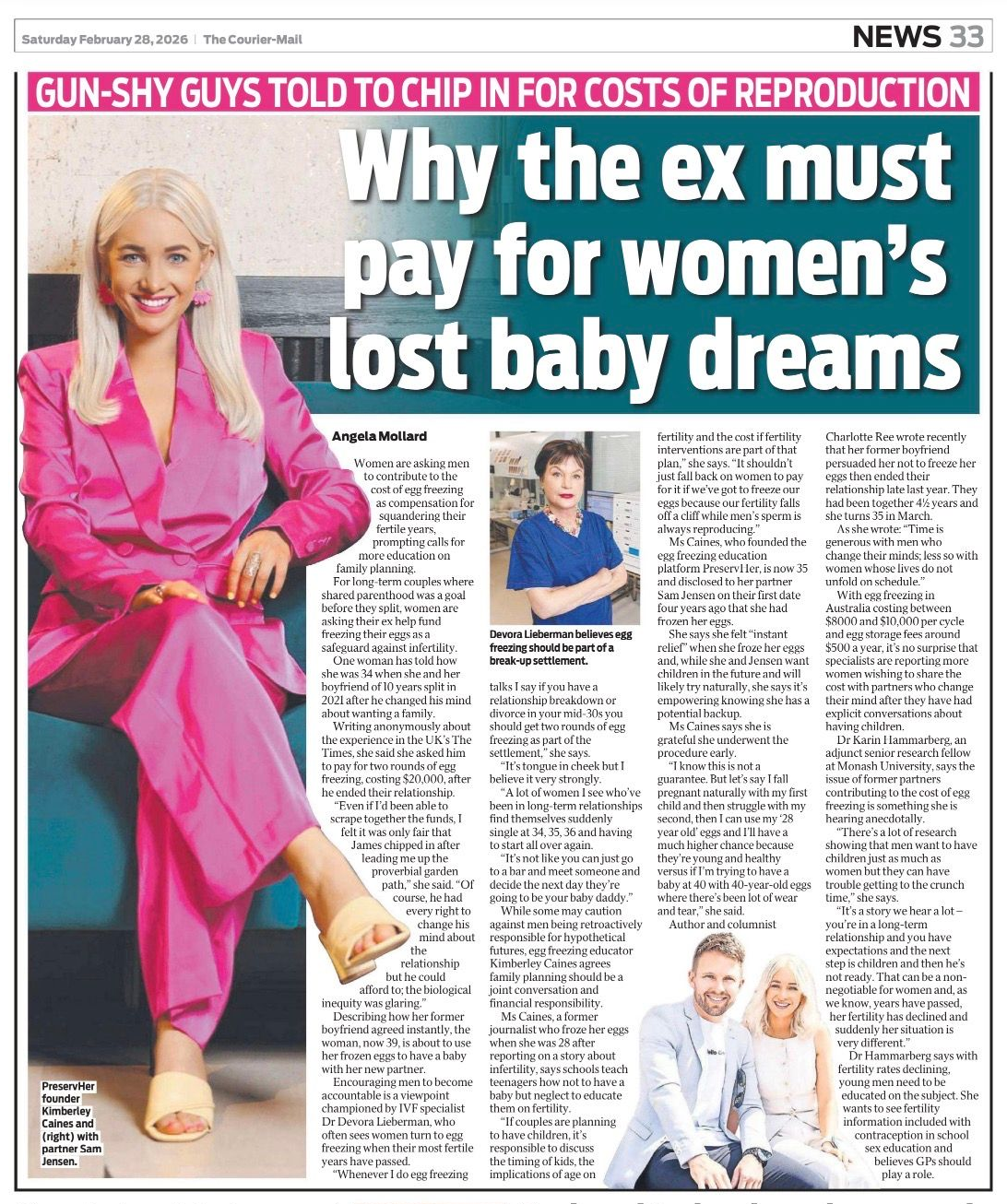
A story about whether a former partner should contribute to the cost of egg freezing has ignited a national debate about responsibility, fairness, and modern relationships.
Last week, I was interviewed in News Corp Australia newspapers about whether fertility should be a joint conversation - and financial consideration - within relationships.
The headline focused on why men should help fund egg freezing after a long-term relationship ended.
Unsurprisingly, the debate quickly centred on one question: Should he have to pay?
But I believe that question misses the bigger issue entirely.
This isn't just about money.
It's about the conversations we're still avoiding.
We readily discuss buying property together.
We discuss career plans, relocations, and retirement strategies.
Yet, conversations about fertility - about biology, timelines, and reproductive realities - are often left unspoken.
Or worse, assumed.
Fertility is often framed as a "women's issue".
But biology doesn't operate in isolation from relationships.
When two people see children as part of their future, understanding the biological window and available options benefits both of them.
Not because one person owes the other.
But because strong partnerships are built on shared awareness.
It's also important to acknowledge why many men reacted strongly to this story.
For some, the idea of financial responsibility after a relationship ends feels unfair or threatening.
Others raised concerns about consent, autonomy, and equality.
Those concerns deserve space in the discussion.
No one should feel legally or morally coerced into funding a decision they do not agree with.
The goal is not obligation - it's transparency and clarity while a relationship is still intact.
What struck me most about the national reaction was how uncomfortable the topic made people.
And that discomfort is telling.
We are comfortable debating financial fairness.
We are less comfortable discussing reproductive timelines.
We are comfortable talking about equality in theory.
We are less comfortable acknowledging that biology is not equal.
That tension sits at the heart of this issue.
Egg freezing is not a guarantee of a family.
It is not a contract between partners.
It is not a punishment for relationships that end.
It is simply one option women may consider when timing and biology do not align.
The real conversation couples should be having is much simpler than "who pays?"
It's this:
- What does having children mean to us?
- When do we realistically see that happening?
- What do we understand about fertility decline?
- What happens if our relationship changes before that timeline?
These are not easy discussions.
But they are far easier at 30 than at 38.
If the reaction to this story has shown us anything, it's that fertility remains one of the last major life decisions we are still uncomfortable discussing openly.
That's precisely why we need to.
Not to assign blame.
Not to create obligation.
But to ensure that both men and women are making informed decisions about their futures.
Because biology doesn't pause while we avoid the conversation.
Kimberley Caines is the founder of PreservHer, a fertility education platform helping women make informed decisions about their reproductive health and life planning.